

Best Way To Study For NFPA CFPS Exam Brilliant CFPS Exam Questions PDF
Updated Verified Pass CFPS Exam - Real Questions and Answers
NEW QUESTION # 53
The vented gas appliance defined as an appliance that operates with a nonpositive vent pressure and a vent static pressure and a vent gas temperature that may cause excessive condensation in the vent is a:
- A. Category IV
- B. Category III
- C. Category II
- D. Category I
Answer: D
NEW QUESTION # 54
What is the maximum allowable sound pressure level (SPL) for a fire alarm system?
- A. 130 dBA
- B. 50 dBA
- C. 100 dBA
- D. 30 dBA
Answer: C
Explanation:
Explanation
According to NFPA 72, the maximum sound pressure level (SPL) for a fire alarm system is 110 dBA at the minimum hearing distance from the audible appliance1.However, this limit can be exceeded if the sound pressure level measured 2 000 mm above floor level is not more than 100 dBA2. Sound pressure level is a measure of the intensity of sound at a given point in space, expressed in decibels (dB). The higher the SPL, the louder the sound.For comparison, a normal conversation is about 60 dB, a jet engine is about 140 dB, and a gunshot is about 160 dB3.References:Sound Pressure Levels - NFPA;NFPA fire alarm sound level - EntirelySafe.com;Subsection 907.5 - Occupantnotification systems - Casetext;How Loud Is a Fire Alarm In Decibels (dB)? With Noise Comparison Chart;The Ontario Building Code | Audibility of Alarm Systems.
NEW QUESTION # 55
Research on conductivity hazard has shown that an individual (firefighter) can safely be subjected on the surface of the body to______.
- A. 5 milliamperes AC
- B. 10 milliamperes AC
- C. 3 milliamperes AC
- D. 15 millamperes AC
Answer: A
NEW QUESTION # 56
while not the only factor used to evaluate the hazard, which of the following is commonly accepted as the most important criterion of the relative hazard of flammable and combustible liquids?
- A. Flammable range
- B. Rate of evaporation
- C. Flash point
- D. Ignition temperature
Answer: C
NEW QUESTION # 57
Air atomizing nozzles which combine compressed gas with a water stream are also known as:
- A. pressure jet nozzles
- B. twin-fluid nozzles
- C. impinging jet nozzles
- D. impingement nozzles
Answer: D
Explanation:
Air Atomizing Nozzles are twin fluid type spray nozzles, usually using compressed air and a liquid to create an atomized droplet.
Available spray patterns within this range include flat fan, full cone and hollow cone. The nozzles are available in pressure design or gravity fed. The air atomizing nozzle is suitable for spraying viscous liquids by using the energy in compressed air to shear the liquid and produce highly atomized sprays with relatively low flow rates.
NEW QUESTION # 58
The thermal inertia of a material is defined as the:
- A. ignition energy of a material based on the quantity of heat energy per unit
- B. direct product of thermal conductivity, density, and heat capacity
- C. minimum combustion rate a solid material must attain in order to ignite under testconditions
- D. direct onset of self-sustained combustion
Answer: A
NEW QUESTION # 59
Semiconductor manufacturing plants have several potential hazards that are not widely encountered in other industries including toxic materials, radio frequency fields, ionizing radiation, and:
- A. flammable liquids
- B. hot work
- C. pyrophoric gases
- D. electrical
Answer: B
Explanation:
http://www2.iccsafe.org/states/seattle/seattle_fire/pdfs/chapter%2018.pdf
NEW QUESTION # 60
Probabilistic fire models are categorized into all of the following EXCEPT
- A. simulation.
- B. statistical.
- C. network.
- D. behavioral.
Answer: C
Explanation:
Explanation
Probabilistic fire models are categorized into network, statistical, simulation, and behavioral models. Network models use graph theory to represent the fire spread and the fire protection system in a building. Statistical models use historical data and probability distributions to estimate the likelihood and consequences of fire scenarios. Simulation models use mathematical equations and numerical methods to describe the physical and chemical processes of fire and its effects on the environment and the occupants. Behavioral models use psychological and sociological theories to predict the human response and evacuation behavior in case of fire.
Network models are not a common category of probabilistic fire models, and they are not mentioned in the sources provided by the user. Therefore, network models are the correct answer.
References:Probabilistic Fire Simulation Assessment Using Simplified Model and Zone Modelling of a Kitchen Fire Scenario;Computer Fire Models for Fire Investigation and Reconstruction;Fire Behavior
NEW QUESTION # 61
Notifying __________ will ensure a quick response by state and federal resources to a major incident.
- A. FBI
- B. state emergency management officials
- C. DHS
- D. FEMA
Answer: B
NEW QUESTION # 62
Clean agents should be designed in accordance with which one of the following NFPA codes?
- A. NFPA 2002
- B. NFPA 2000
- C. NFPA 2003
- D. NFPA 2001
Answer: B
NEW QUESTION # 63
During construction, alteration and demolition in underground operations standpipe systems should be used with a maximum spacing of________.
- A. 300 ft (61 m)
- B. 100 ft (30 m)
- C. 700 ft (61 m)
- D. 400 ft (122 m)
Answer: C
NEW QUESTION # 64
What are two symptoms of low-level exposure to radiation?
- A. Skin tingling and warm feeling
- B. Abdominal cramping and pressure
- C. Nausea and vomiting
- D. Sweating and itching
Answer: C
NEW QUESTION # 65
Which of the following is contagious?
- A. Bubonic plague
- B. Bacillus
- C. Anthrax
- D. Smallpox
Answer: A
NEW QUESTION # 66
Typical fire pump drivers reach maximum brake horsepower between
- A. 65-85% of rated capacity.
- B. 110-125% of rated capacity.
- C. 90-100% of rated capacity.
- D. 140-170% of rated capacity.
Answer: D
Explanation:
Explanation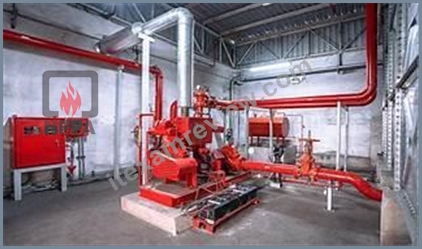
Fire pump
Explore
Typical fire pump drivers reach maximum brake horsepower (BHP) between 140% and 170% of rated capacity, depending on the type and size of the pump. This means that the driver must be able to provide enough power to operate the pump at its peak efficiency point, which is usually beyond the rated capacity. The rated capacity is the flow rate at which the pump is designed to deliver a certain pressure, as specified by NFPA 20, Standard for the Installation of Stationary Pumps for Fire Protection. The maximum BHP is the highest power output required by the pump at any point on its performancecurve. The driver must be sized to match the maximum BHP of the pump, with some allowance for service factor and safety margin.References
:Understanding the Basics of Fire Pumps | Pumps & Systems;How are Engines and Motors Sized for Fire Pumps?; NFPA 20, Standard for the Installation of Stationary Pumps for Fire Protection, 2023 Edition, Chapter 4, Section 4.7.
NEW QUESTION # 67
Which smoke detector type contains a small amount of radioactive material and functions by sensing a decrease in conductance of the air when smoke particles enter the chamber?
- A. Photoelectric
- B. lonization
- C. Light scattering
- D. Cloud chamber air sampling
Answer: B
Explanation:
The smoke detector type that contains a small amount of radioactive material and functions by sensing a decrease in conductance of the air when smoke particles enter the chamber is the ionization smoke detector. Ionization smoke detectors use a small amount of americium-241, a radioactive element, to ionize the air molecules inside a sensing chamber. This creates a low-level electric current between two electrodes. When smoke enters the chamber, it disrupts the ionized air and reduces the current flow. This triggers the alarm to sound. Ionization smoke detectors are more sensitive to small particles of smoke, such as those produced by flaming fires1. However, they may also be more prone to false alarms from cooking or steam, and they require proper disposal of the radioactive source2.
Reference:
Smoke Detector Types: Which Type of Smoke Detector Is Best? - X-Sense
How Does Your Smoke Detector Work? - ThoughtCo
NEW QUESTION # 68
Which of the following would NOT be an appropriate purpose for employing a guard service to protect a property against fire loss?
- A. To carry out procedures for the orderly conduct of some operations on the property
- B. To protect the property at times when the management is not present
- C. To perform routine housekeeping and equipment maintenance operations during nonproduction hours
- D. To facilitate and control the movement of persons into, out of, and within the property
Answer: C
Explanation:
The correct answer is C. To perform routine housekeeping and equipment maintenance operations during nonproduction hours would NOT be an appropriate purpose for employing a guard service to protect a property against fire loss. A guard service is typically hired to provide security and protection for a property, not to perform other tasks that are unrelated to fire prevention or control. Housekeeping and equipment maintenance operations should be done by qualified and authorized personnel who are trained and equipped to handle any potential fire hazards. A guard service may not have the necessary skills, tools, or authority to perform these operations safely and effectively. Moreover, these operations may interfere with the guard service's primary duty of monitoring and patrolling the property for any signs of fire or intrusion12345
NEW QUESTION # 69
Which dry agent is considered twice as effective as ordinary sodium bicarbonate-based dry chemical?
- A. Potassium sulfide
- B. Monoammonium phosphate
- C. Lithium chloride
- D. Potassium bicarbonate
Answer: B
NEW QUESTION # 70
The maximum discharge time permitted for halocarbon clean agent systems is
- A. 10 seconds.
- B. 30 seconds.
- C. 45 seconds.
- D. 60 seconds.
Answer: A
Explanation:
Explanation
The maximum discharge time permitted for halocarbon clean agent systems is10 seconds. This is the requirement of NFPA 2001, which is the standard for clean agent fire extinguishing systems.NFPA 2001 states that the discharge time for halocarbon agents shall not exceed 10 seconds, unless otherwise permitted by the authority having jurisdiction1. Halocarbon agents are synthetic compounds that contain carbon, fluorine, and sometimes other elements, such as hydrogen, chlorine, or bromine.Examples of halocarbon agents include HFC-227ea, HFC-125, and FK-5-1-122. Halocarbon agents work by absorbing heat and interrupting the chemical chain reaction of the fire.They are electrically nonconductive and leave no residue upon evaporation3.Halocarbon agents are suitable for protecting Class A, B, and C fires involving electrical equipment, flammable liquids, and ordinary combustibles4. The discharge time is the time required to release the agent from the storage containers to the protected enclosure.A short discharge time is important to achieve the design concentration of the agent before the fire grows or spreads5.References:
NFPA 2001: Standard on Clean Agent Fire Extinguishing Systems
Clean Agent System Basics | NFPA
Fire Fighting Foams - Chemguard
Clean Agent Fire Suppression Systems | Fike
Category | Rotarex Firetec
NEW QUESTION # 71
Heat transfer oils can be used up to
- A. 650° F(343° C).
- B. 750° F (399C).
- C. 600° F (315° C).
- D. 700° F (371° C).
Answer: A
Explanation:
. 650° F(343° C).
Heat transfer oils are fluids that are used to transfer heat from one source to another in various industrial applications, such as chemical processing, oil refining, power generation, and food processing. Heat transfer oils can be classified into two types: mineral oils and synthetic oils. Mineral oils are derived from petroleum and have a lower cost and a lower flash point than synthetic oils. Synthetic oils are made from organic or silicone compounds and have a higher thermal stability and a higher flash point than mineral oils1 The maximum temperature that heat transfer oils can be used up to depends on the type and quality of the oil, as well as the design and operation of the heat transfer system. Different oils have different boiling points, viscosity, thermal conductivity, and thermal degradation rates. Generally, synthetic oils can withstand higher temperatures than mineral oils, but they are also more expensive and may require special handling and storage1 According to the web search results, the maximum temperature that heat transfer oils can be used up to ranges from 300°C to 400°C (572°F to 752°F), depending on the specific product and manufacturer. For example, the product brochure from Kluber Lubrication states that their heat transfer oils have an application range of operating temperatures up to 550°F (288°C) 2. The product data sheet from Sinopec states that their heat transfer oils can be used up to 540°F (282°C) 3. The product information from Paratherm states that their high temperature heat transfer fluids have service temperatures of 3°C to 357°C (37°F to 675°F) 4. Therefore, based on these sources, the closest answer to the question is B. 650 F(343 C). However, it is important to note that the maximum temperature that heat transfer oils can be used up to may vary depending on the specific conditions and requirements of each application.
Reference:
Heat Transfer Fluids - A Comparison of Types 1
High-temperature heat transfer fluids - Dow 5
Heat Transfer Oils - klueber.com 2
Heat Transfer Oil Suppliers | Heat Transfer Oils include low ... 3
High Temperature Heat Transfer Fluids | Paratherm 4
NEW QUESTION # 72
What type of standpipe system provides 2 1/2 in. (65 mm) hose connections at designated locations in a building for use by the fire department?
- A. Class I
- B. Class IV
- C. Class III
- D. Class II
Answer: A
Explanation:
A Class I standpipe system provides 2 1/2 in. (65 mm) hose connections at designated locations in a building for use by the fire department. A Class I standpipe system is intended to supply water for fire fighting operations by trained personnel using hoses of 1 1/2 in. (40 mm), 1 3/4 in. (45 mm), or 2 in. (50 mm) nominal diameters. A Class I standpipe system is required to deliver a minimum flow rate of 250 gpm (946 L/min) at a minimum residual pressure of 100 psi (6.9 bar) at the most remote hose connection. Reference:
NFPA 14: Standard for the Installation of Standpipe and Hose Systems, 2019 Edition, Section 3.3.4.1 1 Fire Protection Handbook, 20th Edition, Volume 1, Chapter 8, Section 8.2.1.1 2
NEW QUESTION # 73
......
Updated PDF (New 2025) Actual NFPA CFPS Exam Questions: https://examkiller.itexamreview.com/CFPS-valid-exam-braindumps.html
