

100% PASS RATE CPHQ Certification CPHQ Certified Exam DUMP with 656 Questions
Updates For the Latest CPHQ Free Exam Study Guide!
NEW QUESTION # 248
A quality coordinator was asked to evaluate team effectiveness for a struggling quality improvement team.
When interviewed about the team, members say they are frustrated because they do not know what the team is supposed to accomplish. Which of the following should be explored first?
- A. Effectiveness of the team leader
- B. Clarity of team goals
- C. Clarity of team roles
- D. Effectiveness of the facilitator
Answer: B
Explanation:
Team effectiveness depends on clear objectives, roles, and leadership. When team members express frustration due to uncertainty about the team's purpose, the root issue is likely a lack of defined goals.
Option A (Effectiveness of the team leader): While leadership is important, the stated issue is unclear purpose, not leadership performance, so this is not the first priority.
Option B (Clarity of team goals): This is the correct answer. The NAHQ CPHQ study guide states, "Clear team goals are essential for effective quality improvement teams, ensuring alignment and focus" (Domain 3).
The team's frustration about not knowing what to accomplish directly points to unclear goals, which must be addressed first.
Option C (Clarity of team roles): Role clarity is important but secondary to understanding the team's purpose, as roles depend on goals.
Option D (Effectiveness of the facilitator): Facilitation supports meetings, but the core issue is goal clarity, not facilitation skills.
CPHQ Objective Reference: Domain 3: Organizational Leadership, Objective 3.2, "Support effective team dynamics," emphasizes the need for clear goals to ensure team alignment and success. The NAHQ study guide notes that lack of goal clarity is a common barrier to team effectiveness.
Rationale: Addressing unclear goals resolves the team's primary frustration, providing a foundation for role definition and effective leadership, aligning with CPHQ team management principles.
Reference: NAHQ CPHQ Study Guide, Domain 3: Organizational Leadership, Objective 3.2.
NEW QUESTION # 249
Healthcare purchasers and payers are demanding that providers demonstrate their ability to provide high quality
patient care at fair prices. Specifically, they are seeking:
- A. Objective evidence that hospitals and other healthcare organizations satisfy their customers and have desirable
outcomes - B. Objective evidence that hospitals and other healthcare organizations manage their costs well
- C. Baseline information
- D. Current performance
Answer: A,B
NEW QUESTION # 250
Which of the following is a purpose of a Pareto chart?
- A. showing central tendency and variability of a data set
- B. sorting data categories by frequency to enable prioritization
- C. creating a graphical display of the process flow
- D. examining relationships between variables during a snapshot of time
Answer: B
Explanation:
A Pareto chart is a type of bar chart that is used in quality improvement to identify the most significant factors contributing to a particular issue. The chart helps to prioritize problem areas by displaying data categories in descending order of frequency or impact. The principle behind the Pareto chart is the Pareto Principle (also known as the 80/20 rule), which suggests that 80% of problems are often caused by 20% of the causes. By sorting data categories by frequency, the chart enables organizations to focus their efforts on the most critical issues that will have the greatest impact if resolved.
Examining relationships between variables during a snapshot of time (A): This describes a scatter plot, not a Pareto chart.
Creating a graphical display of the process flow (B): This describes a flowchart, not a Pareto chart.
Showing central tendency and variability of a data set (C): This is the purpose of a histogram, not a Pareto chart.
Reference
NAHQ Body of Knowledge: Tools and Techniques for Quality Improvement
NAHQ CPHQ Exam Preparation Materials: Pareto Analysis
NEW QUESTION # 251
Which of the following is an example of using human factors engineering to improve patient safety?
- A. having a second person check medication calculations
- B. performing a root cause analysis on events of harm
- C. providing simulation training for high-risk patient care tasks
- D. using checklists to complete complicated tasks
Answer: D
Explanation:
Human factors engineering focuses on designing systems and processes that account for human capabilities and limitations to improve safety and performance. Using checklists to complete complicated tasks (Answer D) is a prime example of applying human factors engineering to enhance patient safety. Checklists help ensure that critical steps in a process are not overlooked, reducing the likelihood of errors, especially in high- risk, complex tasks such as surgical procedures or medication administration.
The other options, while important for patient safety, do not specifically represent human factors engineering:
* Performing a root cause analysis on events of harm (A) is an investigative process for identifying underlying causes of errors, not a human factors engineering intervention.
* Providing simulation training for high-risk patient care tasks (B) is an educational approach to improving skills and preparedness, not directly related to system design.
* Having a second person check medication calculations (C) is a safety double-check but is more of a verification process than a systemic design change.
References:
* National Association for Healthcare Quality (NAHQ) - Certified Professional in Healthcare Quality (CPHQ) Study Materials.
* Human Factors Engineering in Healthcare, NAHQ Documentation.
=========
NEW QUESTION # 252
In reviewing information offered by the Agency for Healthcare Research and Quality (AHRQ), the quality improvement (QI) specialist recognizes that the three broad aims pursued by the National Quality Strategy are
- A. reduce medical waste, use Lean, and achieve equity and better access to care.
- B. reduce complications, reduce readmissions, and improve health outcomes.
- C. triple aim, reduce utilization, and affordable care.
- D. better care, healthy people/health communities, and affordable care.
Answer: D
Explanation:
The three broad aims pursued by the National Quality Strategy (NQS), as recognized by the Agency for Healthcare Research and Quality (AHRQ), are better care, healthy people/healthy communities, and affordable care. These aims reflect a comprehensive approach to improving healthcare by focusing on enhancing the overall quality of care, improving the health of populations, and reducing the cost of care to ensure it is affordable for all.
* Reduce medical waste, use Lean, and achieve equity and better access to care (A): These are important goals, but they do not summarize the NQS's broad aims.
* Reduce complications, reduce readmissions, and improve health outcomes (B): These are specific targets within the broader framework but not the three broad aims.
* Triple aim, reduce utilization, and affordable care (D): The triple aim concept is related, but it is not identical to the three broad aims of the NQS.
References
* NAHQ Body of Knowledge: National Quality Strategy and Healthcare Improvement
* NAHQ CPHQ Exam Preparation Materials: Understanding National Quality Initiatives
=========
NEW QUESTION # 253
The consensus-building group of diverse stakeholders who reviews and endorses measures for public reporting in the U.S. is known as the
- A. Agency for Healthcare Quality and Research (AHRQ)
- B. National Quality Forum (NQF)
- C. Institute of Medicine (IOM)
- D. Center for Medicare and Medicaid Services (CMS)
Answer: B
Explanation:
The National Quality Forum (NQF) is the consensus-building organization that brings together a diverse group of stakeholders to review and endorse healthcare quality measures for public reporting in the United States. NQF's endorsement is considered the gold standard for healthcare performance measures, and these measures are often used by the Centers for Medicare and Medicaid Services (CMS) and other organizations for public reporting and quality improvement initiatives. NQF's consensus-driven process ensures that the measures are scientifically valid, feasible, and meaningful for improving healthcare quality.
* Center for Medicare and Medicaid Services (CMS) (B): While CMS uses endorsed measures for public reporting, it does not lead the consensus-building process for measure endorsement.
* Institute of Medicine (IOM) (C): Now known as the National Academy of Medicine, the IOM focuses on broader health policy and research but does not specifically endorse public reporting measures.
* Agency for Healthcare Research and Quality (AHRQ) (D): AHRQ conducts research to improve healthcare quality but is not responsible for endorsing measures for public reporting.
References
* NAHQ Body of Knowledge: Healthcare Quality Measurement and Reporting
* NAHQ CPHQ Exam Preparation Materials: Roles of NQF, CMS, AHRQ in Quality Measurement
=========
NEW QUESTION # 254
A patient was in the operating room when a piece of a surgical instrument broke off and was left in the patient's body. The patient was readmitted for removal of the foreign object.
Which of the following would most likely apply in this situation?
- A. Contractual liability
- B. Tort liability
- C. Res ipsa loquitur
- D. Contributory negligence
Answer: C
NEW QUESTION # 255
Following a procedure, a patient is returned to the operating room for removal of a sponge. If no incident report is completed, which of the following will most reliably identify the occurrence?
- A. Claims data
- B. Patient complaint
- C. Peer review
- D. Surgeon disclosure
Answer: A
Explanation:
Claims data is often the most reliable source to detect adverse events like retained surgical items, especially if incident reports are missing due to underreporting. Claims submitted for reimbursement contain diagnostic and procedure codes that flag such events (The Joint Commission, Sentinel Event Reporting, 2024; AHRQ, Patient Safety Indicators, 2023).
* Patient complaints and surgeon disclosure may occur but are less consistent.
* Peer review relies on voluntary disclosure and may not capture all events.
References:
The Joint Commission, Sentinel Event Reporting, 2024
AHRQ, Patient Safety Indicators, 2023
NEW QUESTION # 256
Which of the following is a healthcare quality professional's key responsibility for supporting organizational quality governance?
- A. presenting regular financial updates to the organization's leaders
- B. assessing the board's understanding of quality topics
- C. deciding which quality initiatives will be set as priorities
- D. updating board members on key performance indicators
Answer: D
Explanation:
Explanation: A healthcare quality professional's key responsibility in quality governance is updating board members on key performance indicators (KPIs) (B), such as infection rates or patient satisfaction, to support data-driven oversight. Assessing board understanding (A),presenting financial updates (C), or deciding priorities (D) are not primary roles. NAHQ prioritizes KPI reporting for governance.
NAHQ CPHQ Study Guide, Organizational Leadership Section, "Quality Governance and Board Reporting"; NAHQ Code of Practice, Principle 3: Information Management.
NEW QUESTION # 257
A performance improvement council has been directed to set up a communication plan for spreading an innovative telehealth program throughout the healthcare system. Which of the following groups must the council include in the communication plan?
- A. market competitors
- B. local media
- C. state legislators
- D. adopter audiences
Answer: D
Explanation:
When a performance improvement council sets up a communication plan for spreading an innovative telehealth program throughout a healthcare system, the plan must include adopter audiences. Adopter audiences are the various groups within the healthcare system that will need to adopt the new program, including clinicians, administrators, and other staff members who will be directly involved in or affected by the implementation.
* Importance of Adopter Audiences: Engaging adopter audiences is crucial because their buy-in, understanding, and participation are essential for the successful adoption and integration of the telehealth program. Communication should be tailored to address their concerns, provide training, and outline the benefits of the innovation.
* Comparison to Other Options:
* A. market competitors: Involving market competitors in the communication plan is not appropriate, as they are external entities and could have conflicting interests.
* C. state legislators: While state legislators may play a role in regulatory or policy support, they are not the primary focus of a communication plan aimed at internal adoption within the healthcare system.
* D. local media: Local media can be useful for public relations and informing the broader community, but they are not directly involved in the adoption and implementation of the program within the healthcare system.
References: NAHQ resources highlight the importance of focusing on adopter audiences when communicating and implementing new healthcare initiatives, ensuring that the relevant stakeholders are informed, engaged, and prepared to support the change.
=========
NEW QUESTION # 258
In an aging population, one of the challenges associated with the use of practice guidelines is
- A. changing the behavior to improve care is a complex process.
- B. the cost of instructions to implement new guidelines increases yearly.
- C. most practice guidelines only address a single issue, not multiple co-morbidities.
- D. the constant evolution of healthcare makes it difficult to keep practice guidelines relevant.
Answer: C
Explanation:
In an aging population, one of the significant challenges associated with the use of practice guidelines is that most practice guidelines only address a single issue and do not consider the multiple co-morbidities that are common in older patients. As the population ages, patients often have complex health needs that involve several chronic conditions simultaneously. Single-issue guidelines may not adequately address these complexities, leading to potential gaps in care.
The cost of instructions to implement new guidelines increases yearly (A): While costs may be a concern, the primary challenge in an aging population is addressing co-morbidities.
The constant evolution of healthcare makes it difficult to keep practice guidelines relevant (B): This is a challenge, but it applies broadly, not specifically to the aging population.
Changing behavior to improve care is a complex process (C): This is true but is a broader challenge that applies to many aspects of healthcare improvement, not specifically to the aging population.
Reference
NAHQ Body of Knowledge: Challenges in Implementing Practice Guidelines
NAHQ CPHQ Exam Preparation Materials: Practice Guidelines and Comorbidities
NEW QUESTION # 259
A quality professional is assessing team performance. Which of the following results would be associated when applying evaluation criteria to assess productivity?
- A. Increased knowledge of improvement
- B. Unmet goals
- C. Team dissatisfaction
- D. Positive culture of improvement
Answer: D
Explanation:
A positive culture of improvement reflects a productive team environment where continuous learning and quality enhancement are prioritized. The NAHQ CPHQ Detailed Content Outline highlights the importance of evaluating team effectiveness, which encompasses fostering a culture that supports ongoing improvement and collaboration.cdn.nahq.org Such a culture encourages team members to engage proactively in quality initiatives, leading to sustained improvements in healthcare delivery.
NEW QUESTION # 260
An orthopedic surgery practice has been working on Improving patient safety for the last 3 years.
The following data table is available: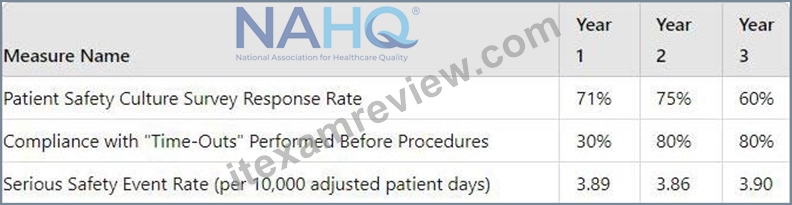
Which of the following Is the most appropriate conclusion about patient safety outcomes?
- A. The patient safety culture has remained consistent.
- B. The safety event rate has remained stable
- C. Patient safety outcomes have improved.
- D. The increase in "lime-outs" has reduced patient harm.
Answer: B
NEW QUESTION # 261
Which of the following represents a medically underserved population?
- A. families with a household size greater than 7.2
- B. patients living below the Income poverty line
- C. patients living within S miles of an urban area
- D. high risk obstetric patients in the third trimester
Answer: B
Explanation:
A medically underserved population is a population of individuals with either a large elderly population, high infant mortality rate, high level of poverty or lack of providers1. This definition aligns with option D, which refers to patients living below the income poverty line. These individuals often lack access to primary care health services2, which is a key characteristic of medically underserved populations. Therefore, the answer is D: patients living below the Income poverty line.
NEW QUESTION # 262
A new pediatric psychiatric unit will open in one year. The utilization coordinator is responsible for developing the utilization management program. The program's success will depend on which of the following factors?
- A. developing the program and presenting it to the appropriate staff members
- B. involving the team members in the development of the program
- C. providing educational in-services to all team members involved
- D. obtaining approval from the chief psychiatrist at each stage of development
Answer: B
Explanation:
The success of a utilization management program for a new pediatric psychiatric unit will largely depend on involving the team members in the development of the program. Engaging team members in the process ensures that the program is practical, addresses real-world challenges, and gains buy-in from those who will be implementing it. Team involvement fosters collaboration, allows for the inclusion of diverse perspectives, and enhances the likelihood of the program's success.
Obtaining approval from the chief psychiatrist at each stage of development (A): While important for ensuring alignment with clinical leadership, it does not replace the need for broader team involvement.
Developing the program and presenting it to the appropriate staff members (B): This approach is less effective as it does not involve the team in the development process, which is crucial for successful implementation.
Providing educational in-services to all team members involved (D): Education is important, but the success of the program relies more on the team's involvement in its creation than on subsequent training alone.
References
NAHQ Body of Knowledge: Program Development and Team Involvement in Healthcare NAHQ CPHQ Exam Preparation Materials: EffectiveUtilization Management Program Development
=========
NEW QUESTION # 263
The following data are known: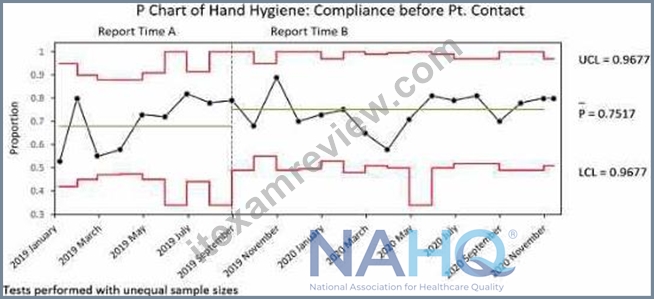
Which of the following accurately describes this chart?
- A. The mode was 0.7517 In Report Time B.
- B. There were no special cause variations.
- C. There was one outlier in Report Time A.
- D. The lower control limits were the same in Report Time A and B.
Answer: D
Explanation:
The chart you've provided is a P chart, which is used to measure the proportion of nonconformities in a process over time, in this case, hand hygiene compliance before patient contact. This type of control chart is particularly useful for analyzing the performance of processes in areas like healthcare compliance.
From the visual analysis of the chart:
Upper Control Limit (UCL) and Lower Control Limit (LCL) are clearly labeled and appear consistent across both Report Time A and B at 0.9677. This addresses option A, indicating that the lower control limits remain unchanged between the two reporting periods.
Central Line (P), which represents the average proportion across the data set, is also consistent across both periods at 0.7517.
Outliers and Special Cause Variations would typically be indicated by points falling outside the control limits or showing non-random patterns that suggest shifts or trends.
NEW QUESTION # 264
A more proactive posture would be to develop an organization-wide approach to quality measurement that meets both internal and external demands.
This approach is:
- A. Not a task that can be completed once, rather a journey that has many potential pitfalls and detours
- B. A task that should be done in chunks of improvement process
- C. A task that should be completed through a series of related activities
- D. A task that should be completed at once
Answer: A
NEW QUESTION # 265
Which of the following is required for the successful development of clinical pathways?
- A. Patient education materials
- B. Staff education
- C. Quality improvement tools
- D. Physician involvement
Answer: D
Explanation:
Clinical pathways are evidence-based, standardized care plans designed to optimize patient outcomes and reduce variations in care. Their successful development requires collaboration among key stakeholders, with physician involvement being critical due to their role in clinical decision-making and protocol adoption.
Option A (Staff education): While staff education is important for implementing clinical pathways, it is a secondary step that follows pathway development. Education ensures adherence but is not a requirement for creating the pathways themselves.
Option B (Patient education materials): Patient education materials support patient engagement but are not essential for developing clinical pathways, which focus on provider-driven care processes.
Option C (Quality improvement tools): Quality improvement tools (e.g., flowcharts, PDSA cycles) may be used to refine pathways, but they are not a requirement for development. The primary need is clinical expertise and stakeholder input.
Option D (Physician involvement): Physician involvement is essential for developing clinical pathways, as they provide clinical expertise, ensure pathways align with evidence-based practice, and drive adoption among peers. NAHQ CPHQ study materials emphasize that multidisciplinary collaboration, particularly with physicians, is critical for creating effective pathways, as physicians are key decision-makers in patient care protocols.
Reference: NAHQ CPHQ Study Guide, Domain 4: Performance and Process Improvement, highlights the importance of physician engagement in developing clinical pathways to ensure clinical relevance and successful implementation.
NEW QUESTION # 266
In addition to the mean, which of the following are measures of central tendency?
- A. Standard deviation and variance
- B. Standard deviation and median
- C. Mode and median
- D. Mode and variance
Answer: C
Explanation:
Measures of central tendency describe the center of a data distribution, commonly used in quality data analysis to summarize performance metrics.
Option A (Standard deviation and variance): These are measures of dispersion, not central tendency, as they describe data spread.
Option B (Standard deviation and median): Median is a measure of central tendency, but standard deviation is not.
Option C (Mode and variance): Mode is a measure of central tendency, but variance is not.
Option D (Mode and median): This is the correct answer. The NAHQ CPHQ study guide states, "Measures of central tendency include the mean, median, and mode, representing the average, middle value, and most frequent value, respectively" (Domain 2).
CPHQ Objective Reference: Domain 2: Health Data Analytics, Objective 2.1, "Understand statistical measures for data analysis," includes central tendency measures. The NAHQ study guide notes, "Mean, median, and mode are essential for summarizing quality data" (Domain 2).
Rationale: Mode and median, along with mean, are standard measures of central tendency, as per CPHQ's statistical analysis principles.
Reference: NAHQ CPHQ Study Guide, Domain 2: Health Data Analytics, Objective 2.1.
NEW QUESTION # 267
Feedback from patients and their families will provide rich information for quality improvement work. For these efforts to be successful, you should consider some questions.
Which of the following is NOT out of those questions?
- A. Who will review the data?
- B. How frequently do you need to measure your performance to achieve your name?
- C. What is your aim for improvement?
- D. What was your last year budget?
Answer: D
NEW QUESTION # 268
Which part of a job description should be used in a criteria-based performance evaluation?
- A. Duties and responsibilities
- B. Working conditions
- C. Qualifications
- D. Salary grade
Answer: A
NEW QUESTION # 269
A quality Improvement team has Identified specific changes to Implement for a quality Improvement Initiative. As the next step, the team would like to establish a concrete timeline for implementation.
Which of the following is the best tool to use for this step?
- A. Gantt chart
- B. process map
- C. bar graph
- D. Ishikawa diagram
Answer: A
Explanation:
A process map is a tool that shows the sequence of steps or activities involved in a process, and identifies the inputs, outputs, and decision points. It can help to identify waste, variation, and inefficiencies in a process, and to design or redesign a process for improvement. However, it does not show the time required or allocated for each step or activity, nor the dependencies or interrelationships among them. Therefore, it is not the best tool to use for establishing a timeline for implementation.
A Gantt chart is a tool that shows the tasks or phases of a project, the duration and order of each task or phase, the milestones or deliverables, and the progress or status of each task or phase. It can help to plan and schedule a project, to monitor and communicate its progress, to identify critical tasks or phases, and to allocate resources and responsibilities. Therefore, it is the best tool to use for establishing a timeline for implementation.
An Ishikawa diagram (also known as a fishbone diagram or a cause-and-effect diagram) is a tool that shows the possible causes of a problem or an effect, and organizes them into categories or branches. It can help to identify the root causes of a problem, to brainstorm potential solutions, and to prioritize areas for improvement. However, it does not show the time or sequence of the causes or solutions, nor the tasks or phases of a project. Therefore, it is not the best tool to use for establishing a timeline for implementation.
A bar graph (also known as a histogram or a column chart) is a tool that shows the frequency or distribution of data in different categories or groups, using vertical or horizontal bars. It can help to compare data across categories or groups, to identify patterns or trends, and to display numerical information visually. However, it does not show the time or sequence of the data, nor the tasks or phases of a project. Therefore, it is not the best tool to use for establishing a timeline for implementation.
Reference: Gantt Chart | Digital Healthcare Research
Gantt Chart | Turas | Learn
Chart Template - Gantt Chart - Health Quality Council
Project Planning - Institute for Healthcare Quality Improvement
Best examples of timelines, Gantt charts, and roadmaps for the healthcare sector [HQ Principles | NAHQ]
NEW QUESTION # 270
A hospital installed a new patient safety event reporting system. During the failure modes and effects analysis (FMEA), decreased use of the system and complexity of reporting were identified as potential failures.
What should the team use to determine which failure mode to address first?
- A. risk priority number
- B. detectability
- C. frequency of occurrence
- D. severity
Answer: A
Explanation:
In the context of a Failure Modes and Effects Analysis (FMEA) for a new patient safety event reporting system, the team should use the risk priority number (RPN) to determine which failure mode to address first.
Here's why:
Comprehensive Assessment: The RPN is calculated by multiplying the values assigned to the severity, frequency of occurrence, and detectability of a failure mode. This number provides a comprehensive assessment of the risk associated with each potential failure.
Prioritization: By using the RPN, the team can prioritize which failure modes to address first based on the overall risk they pose. The higher the RPN, the more critical it is to address that failure mode. Efficient Resource Allocation: Addressing the highest RPN first ensures that resources are allocated to the areas that have the greatest potential impact on patient safety, making the risk mitigation process more efficient.
Balanced Decision-Making: The RPN allows the team to consider not just how often a failure might occur, but also how severe the consequences would be and how easy it is to detect before it causes harm. This balanced approach ensures that all relevant factors are considered in decision-making.
Reference: (Based on Healthcare Quality NAHQ documents and resources)
NAHQ Modules on Risk Management and FMEA.
Quality Management in Health Care, Chapter on Using Risk Priority Number in FMEA.
NEW QUESTION # 271
Sampling is a key that healthcare professionals need to develop. If a process does not generate a lot of data, you probably will analyze all the occurrences of an event and not need to consider sampling.
Sampling usually is not required when the measure is (Choose two):
- A. A strata
- B. A rate
- C. A percentage
- D. A step by step process
Answer: B,C
NEW QUESTION # 272
......
Best CPHQ Exam Preparation Material with New Dumps Questions https://examkiller.itexamreview.com/CPHQ-valid-exam-braindumps.html
