

2025 New Integration-Architect Exam Questions Real Salesforce Dumps
Course 2025 Integration-Architect Test Prep Training Practice Exam Download
Salesforce Integration-Architect (Salesforce Certified Integration Architect) is a popular certification exam that is designed to test the skills and knowledge of professionals who are responsible for designing, building, and managing complex integrations between Salesforce and other systems. Salesforce Certified Integration Architect certification is intended for architects, developers, and technical leads who have a deep understanding of integration patterns, best practices, and design considerations. By passing Integration-Architect exam, professionals can demonstrate their expertise in Salesforce integration and enhance their career prospects.
NEW QUESTION # 24
Northern Trail Outfitters (NTO) uses a custom mobile app to interact with their customers.
One of the features of the app are Salesforce Chatter Feeds. NTO wants to automatically post a Chatter item to Twitter whenever the post includes the #thanksNTO hashtag.
Which API should an Integration Architect use to meet this requirement?
- A. Streaming API
- B. REST API
- C. Connect REST API
- D. Apex REST
Answer: C
Explanation:
The Connect REST API is designed to access Chatter feeds and social data such asusers, groups, followers, and files. By using this API, the integration can query the Chatter posts that include the #thanksNTO hashtag and post them to Twitter using another API. The REST API, Streaming API, and Apex REST are not specific to Chatter and do not provide the same level of functionality and ease ofuse as the Connect REST API2 References: 1: Fire and Forget Pattern 2: Connect REST API
NEW QUESTION # 25
Northern Trail Outfitters (NTO) use Salesforce to track leads, opportunities, and to capture order details. However, Salesforce isn't the system that holds or processes orders. After the order details are captured in Salesforce, an order must be created in the remote system, which manages the orders lifecylce. The Integration Architect for the project is recommending a remote system that will subscribe to the platform event defined in Salesforce.
Which integration pattern should be used for this business use case?
- A. Fire and Forget
- B. Remote Call In
- C. Batch Data Synchronization
- D. Request and Reply
Answer: A
NEW QUESTION # 26
Northern Trail Outfitters' (NTO) Salesforce org usually goes through 8k-10k batches a day to synch data from external sources. NTO's Integration Architect has received requirements for a new custom object, FooBarc, for which 90M records will need to be loaded into the org. Once complete, 20GB (about 30M records) needs to be extracted to an external auditing system.
What should the architect recommend using to meet these requirements in a day?
- A. Insert using Bulk API 2.0 and query using REST API.
- B. Insert using Bulk API 1.0 and query using REST API.
- C. Insert and query using Bulk API 2.0.
- D. Insert and query using Bulk API 1.0.
Answer: C
Explanation:
Answer D is valid because using Bulk API 2.0 for both inserting and querying data canmeet the requirements of loading and extracting large volumes of data in a day. Bulk API 2.0 is a RESTful API that allows creating, updating, deleting, or querying millions of records asynchronously by uploading or downloading CSV or JSON files. Bulk API2.0 has several advantages over Bulk API 1.0, such as:
It does not count against the daily limit of 5,000 batches per rolling 24-hour period.
It supports PK Chunking for queries, which automatically splits large data sets into manageable chunks based onthe primary key.
It simplifies the job lifecycle and reduces the number of API calls needed to perform a bulk operation.
Answer A is not valid because using Bulk API 2.0 for inserting data and REST API for querying data is not an optimal solution for handling large volumes of data in a day. REST API is a synchronous API that allows creating, updating, deleting, or querying individual records or small batches of records using HTTP methods.
REST API has several limitations and drawbacks for this use case, such as:
It counts against the daily limit of 15,000 API requests per 24-hour period.
It does not support PK Chunking for queries, which means that large data sets may exceed the query timeout or heap size limits.
It requires more API calls and processing time to perform a bulk operation than Bulk API 2.0.
Answer B is not valid because using Bulk API 1.0 for both inserting and querying data is not a feasible solution for handling large volumes of data in a day. Bulk API 1.0 is a SOAP-based API that allows creating, updating, deleting, or querying millions of records asynchronously by uploading or downloading XML or CSV files. Bulk API 1.0 has several limitations and drawbacks compared to Bulk API 2.0, such as:
It counts against the daily limit of 5,000 batchesper rolling 24-hour period, which may not be enough to load and extract 90M and 30M records respectively.
It does not support JSON format for data files, which may not be compatible with some external systems or applications.
It requires more API calls andcomplexity to manage the job lifecycle and handle errors or retries than Bulk API 2.0.
Answer C is not valid because using Bulk API 1.0 for inserting data and REST API for querying data is not a suitable or reliable solution for handling large volumes ofdata in a day. As explained above, both Bulk API
1.0 and REST API have limitations and drawbacks that may affect the performance, efficiency, and scalability of the integration.
NEW QUESTION # 27
Which two requirements should the Salesforce Community Cloud support for self-registration and SSO?
Choose 2 answers
- A. SAML SSO and Registration Handler
- B. OpenId Connect Authentication Provider and just-in-time provisioning
- C. SAML SSO and just-in-time provisioning
- D. OpenId Connect Authentication Provider and Registration Handler
Answer: C,D
Explanation:
Explanation
OpenId Connect Authentication Provider and Registration Handler, and SAML SSO and just-in-time provisioning are two requirements that the Salesforce Community Cloud can support for self-registration and SSO. OpenId Connect is a protocol that allows users to authenticate with an external identity provider and access Salesforce resources. A registration handler is a class that implements the Auth.RegistrationHandler interface and defines the logic for creating or updating a user in Salesforce after authentication. SAML SSO is a protocol that allows users to log in to Salesforce with a single click, using an assertion from an identity provider that confirms the user's identity. Just-in-time provisioning is a feature that allows Salesforce to create or update a user account based on the information in the SAML assertion. References: Certification - Integration Architect - Trailhead, [OpenID Connect Authentication Providers], [SAML Single Sign-On (SSO) Service for Salesforce]
NEW QUESTION # 28
Northern Trail Outfitters (NTO) is planning to create a native employee-facing mobile app with the look and feel of Salesforce Lightning Experience. The mobile app needs to integrate with NTO's Salesforce org.
Which Salesforce API should be used to implement this integration?
- A. Connect REST API
- B. User Interface API
- C. REST API
Answer: B
NEW QUESTION # 29
A call center manager uses a custom dashboard to track Case related metrics. The manager wants a component to display the number of closed Cases in real time.
What type of event should be used to meet this requirement?
- A. Push Topic Event
- B. Change Data Capture Event
- C. Platform Event
- D. Generic Event
Answer: B
Explanation:
Change Data Capture Event is the best option to meet this requirement. Change Data Capture Event is a type of streamingevent that notifies subscribers of changes to Salesforce records, such as creation, update, delete, and undelete operations1. By subscribing to Change Data Capture Event for the Case object, the dashboard component can receive real-time updates on the number of closed Cases. Push Topic Event is another type of streaming event that notifies subscribers of changes to Salesforce records that match a SOQL query2. However, Push Topic Event has some limitations, such as not supporting all SOQL features and not capturing delete and undelete operations3. Platform Event is a type of streaming event that delivers custom notifications within the Salesforce platform or from external sources4. Platform Event is not suitable for this requirement because it is not tied to Salesforce records and requires custom logic to publish and subscribe. Generic Event is a type of streaming event that sends custom JSON notifications to subscribers without a predefined schema5. Generic Event is not suitable for this requirement because it is not tied to Salesforce records and requires custom logic to publish and subscribe.
NEW QUESTION # 30
What is the first thing an Integration Architect should validate if a callout from a LightningWeb Component to an external endpoint is failing?
- A. The endpoint URL has been added to Remote Site Settings.
- B. The endpoint domain has been added to Cross-Origin Resource Sharing.
- C. The endpoint URL has been added to Content Security Policies.
- D. The endpoint URL has added been to an outbound firewall rule.
Answer: B
Explanation:
Explanation
The first thing an integration architect should validate if a callout from a Lightning Web Component to an external endpoint is failing is the endpoint domain has been added to Cross-Origin Resource Sharing (CORS).
CORS is a mechanism that allows web browsers to make requests to servers on different origins, such as different domains, protocols, or ports. CORS requires the server to send back a special header that indicates whether the browser is allowed to access the resource or not. If the endpoint domain is not added to the CORS whitelist in Salesforce, the browser will block the callout and throw an error. Option B is not correct because Content Security Policies (CSP) are used to control what resources can be loaded on a Visualforce or Lightning page, such as scripts, stylesheets, images, etc. CSP does not affect the callout from a Lightning Web Component to an external endpoint. Option C is not correct because outbound firewall rules are used to restrict the network traffic from Salesforce to external systems. Firewall rules are configured at the network level, not at the Salesforce level. Option D is not correct because Remote Site Settings are used to specify the domains that are allowed for callouts from Apex code, not from Lightning Web Components. References:
Working with CORS and CSP to Call APIs from LWC
[Cross-Origin Resource Sharing (CORS)]
NEW QUESTION # 31
An enterprise architect has requested the Salesforce Integration architect to review the following (see diagram & description) and provide recommendations after carefully considering all constraints of the enterprise systems and Salesforce platform limits.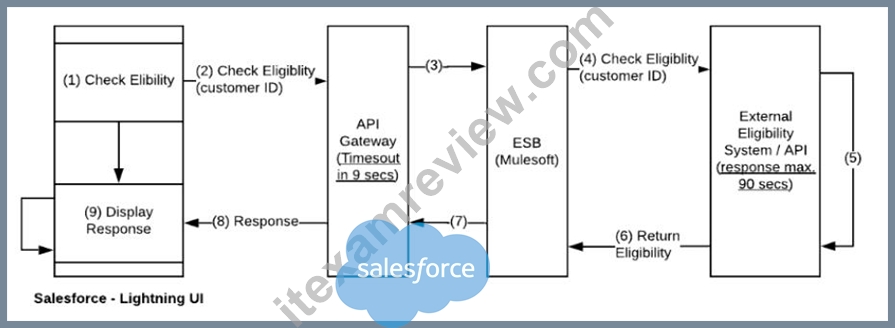
* About 3,000 phone sales agents use a Salesforce Lightning UI concurrently to check eligibility of a customer for a qualifying offer.
* There are multiple eligibility systems that provides this service and are hosted externally. However, their current response times could take up to 90 seconds to process and return (there are discussions to reduce the response times in future, but no commitments are made).
* These eligibility systems can be accessed through APIs orchestrated via ESB (MuleSoft).
* All requests from Salesforce will have to traverse through customer's API Gateway layer and the API Gateway imposes a constraint of timing out requests after 9 seconds.
Which three recommendations should be made?
Choose 3 answers
- A. When responses are received by Mule, create a Platform Event in Salesforce via Remote-Call-In and use the empAPI in the lightning UI to serve 3,000 concurrent users.
- B. ESB (Mule) with cache/state management to return a requestID (or) response if available from external system.
- C. Implement a 'Check Update' button that passes a requestID received from ESB (user action needed).
- D. Use Continuation callouts to make the eligibility check request from Salesforce from Lightning UI at page load.
- E. Recommend synchronous Apex call-outs from Lightning UI to External Systems via Mule and implement polling on API gateway timeout.
Answer: B,C,D
NEW QUESTION # 32
Northern Trail Outfitters (NTO) uses Salesforce to track leads, opportunities and order details that convert leads to customers. However, Orders are managed by an external (remote) system. Sales representatives want to view and update real-time order information in Salesforce. NTO wants the data to only persist in the external system.
Which type of Integration should an architect recommend to meet this business requirement?
- A. Batch Processing
- B. Data Visualization
- C. Data Synchronization
- D. Process Orchestration
Answer: B
Explanation:
https://developer.salesforce.com/docs/atlas.en-us.integration_patterns_and_practices.meta/integration_patterns_and_practices/integ_pat_data_virtualization.htm
NEW QUESTION # 33
A customer is migrating from an old legacy system to Salesforce. As part of the modernization effort, they would like to integrate al existing systems that currently work with their legacy application with Salesforce.
Which three constraints and pain-points should an integration architect consider when choosing the integration pattern/mechanism?
Choose 3 answers
- A. System types - APIs, File systems, Email
- B. Error handling mechanisms
- C. Data Volume and Processing volume
- D. Multi-language and multi-currency requirement
- E. Reporting and usability requirements
Answer: A,B,C
Explanation:
Explanation
The system types, the error handling mechanisms, and the data volume and processing volume are three constraints and pain-points that an integration architect should consider when choosing the integration pattern/mechanism. The system types determine what kind of interfaces and protocols are available or required for the integration, such as APIs, file systems, email, etc. The error handling mechanisms ensure that the integration can handle any failures or exceptions gracefully and provide appropriate logging and notification.
The data volume and processing volume affect the performance and scalability of the integration, as well as the choice of synchronous or asynchronous methods. Reference: Salesforce Integration Architecture Designer Resource Guide, page 17
NEW QUESTION # 34
A large enterprise customer has decided to implement Salesforce as their CRM. The current system landscape includes the following:
1. An Enterprise Resource Planning (ERP) solution that is responsible for Customer Invoicingand Order fulfillment.
2. A Marketing solution they use for email campaigns.
The enterprise customer needs their sales and service associates to use Salesforce to view and log their interactions with customers and prospects in Salesforce.
Which system should be the System of record for their customers and prospects?
- A. ERP with all prospect data from Marketing and Salesforce.
- B. New CustomDatabase forCustomers and Prospects.
- C. Marketing with all customer data from Salesforce and ERP.
- D. Salesforce with relevant Marketing and ERP information.
Answer: D
Explanation:
Option C is correct because Salesforce should be the system of record for their customers and prospects, as it is the CRM solution that the sales and service associates use to view and log their interactions with them. Salesforce can also integrate with the Marketing and ERP solutions to display relevant information from those systems, such as campaign history, invoices, and orders12 Option A is incorrect because ERP is not a suitable system of record for customers and prospects, as it is mainly focused on invoicing and order fulfillment. ERP may not have all the data that the sales and service associates need to interactwith them, such as contact details, preferences, activities, and opportunities. ERP may also have different datamodels and definitions than Salesforce and Marketing, which can cause data quality and consistency issues3 Option B is incorrect because Marketing is not a suitable system of record for customers and prospects, as it is mainly focused on email campaigns. Marketing may not have all the data that the sales and service associates need to interact with them, such as account information, service cases, contracts, and quotes. Marketing may also have different data models and definitions than Salesforce and ERP, which can cause data quality and consistency issues.
Option D is incorrect because creating a new custom database for customers and prospects is not a feasible orefficient solution, as it would require additional development, maintenance, and integration costs. It would also create another layer of complexity and potential data duplication in the system landscape. Salesforce already provides a robust and flexibleplatform for managing customer and prospect data, which can be easily customized and integrated with other systems.
References: 1: Salesforce CRM - The Definitive Guide 2: SalesforceIntegration Cloud - Connect Any App, Data, or Device 3: What Is ERP? | Oracle : Salesforce vs ERP: What's the Difference? : Marketing Cloud - Digital Marketing Platform : Salesforce vs Marketing Cloud: What's the Difference? : Salesforce Platform - Build Apps Fast : Why You Shouldn't Build Your Own CRM System
NEW QUESTION # 35
A customer imports data from an external system into Salesforce using Bulk API. These jobs have batch sizes of 2000 and are run in parallel mode. The batc fails frequently with the error "Max CPU time exceeded". A smaller batch size will fix this error.
Which two options should be considered when using a smaller batch size?
Choose 2 answers
- A. Smaller batch size may increase time required to execute bulk jobs.
- B. Smaller batch size can trigger "Too many concurrent batches" error.
- C. Smaller batch size may exceed the concurrent API request limits.
- D. Smaller batch size may cause record-locking errors.
Answer: A,D
NEW QUESTION # 36
A Salesforce customer is planning to roll out Salesforce for all their Sales and Service staff.
Senior Management has requested that monitoring is to be in pla for Operations to notify any degradation in Salesforce performance.
How should an integration consultant implement monitoring?
- A. Identify critical business processes and establish automation to monitor performance against established benchmarks.
- B. Request Salesforce to monitor the Salesforce instance and notify when there is degradation in performance.
- C. Use APIEVENT to track all user-initiated API calls through SOAP, REST or BULK APIs.
- D. Use Salesforce limits API to capture current API usage and configure alerts for monitoring.
Answer: A
Explanation:
Explanation
The integration consultant should implement monitoring by identifying critical business processes and establishing automation to monitor performance against established benchmarks. This approach can help detect and diagnose any degradation in Salesforce performance, such as slow response time, high error rate, or low availability. The automation can use various tools and methods, such as platform events, event monitoring, health check, or third-party monitoring services123 References: Proactive Monitoring - Salesforce.com, 17 Free Ways to Monitor Your Salesforce Org | Salesforce Ben, Measure Lightning Experience Performance and Experienced ... - Trailhead
NEW QUESTION # 37
Northern Trail Outfitters (NTO) has an affiliate company that would like immediate notifications of changes to opportunities in the NTO Salesforce instance. The affiliate company has a CometD client available.
Which solution is recommended in order to meet the requirement?
- A. Configure External Services to call the subscriber in Apex in the Onchange Trigger event as part of the flow.
- B. A Implement a polling mechanism in the client that calls the SOAP API getupdated method to get the ID values of each updated record.
- C. Create a PushTopic update event on the Opportunity Object to allow the subscriber to react to the streaming API.
- D. Create a connected app in the affiliate org and select the "Accept CometD API Requests".
Answer: C
NEW QUESTION # 38
Sales representatives at Universal Containers (UC) use Salesforce Sales Cloud as their primary CRM. UC owns a legacy homegrown application that stores a copy of customer dataas well. Sales representatives may edit or update Contact records in Salesforce if there is a change.
Both Salesforce and the homegrown application should be kept synchronized for consistency. UC has these requirements:
1. When a Contact record in Salesforce is updated, the external homegrown application should be
2. The synchronization should be event driven.
3. The integration should be asynchronous.
Which option should an architect recommend to satisfy the requirements?
- A. Leverage Change Data Capture to track changes to theContact object and write a CometD subscriber on the homegrown application.
- B. Leverage Platform Events to publish a custom event message containing changes to the Contact object.
- C. Write an Apex Trigger with the @future annotation.D Use an ETL tool to keep Salesforce and the homegrown application in sync on a regular candence.
Answer: A
Explanation:
Leverage Change Data Capture to track changes to the Contact object and write a CometD subscriber on the homegrown application. This solution meets the requirements of keeping Salesforce and the homegrown application synchronized for consistency, using event-driven and asynchronous integration. Change Data Capture is a feature that allows you to receive near real-time notifications of changes to Salesforce records, such as inserts, updates, deletes, and undeletes. You can use Change Data Capture to track changes to the Contact object, and publish them as events to an event bus. CometD is a protocol that allows you to subscribe to events from the event bus using a streaming API. You can write a CometD subscriber on the homegrown application, and use it to receive the events and update the customer data accordingly.
References: Certification - Integration Architect - Trailhead, [Change Data Capture Developer Guide],
[Streaming API Developer Guide]
NEW QUESTION # 39
KiA B2C Enterprise Customer has the following use case that involves processing payment from an external payment gateway service in Salesforce.
1. Customer requests Customer Service Representative (CSR) for a Service upgrade.
2. Customer provides credit card details to CSR for payment.
3. CSR submits payment information in Salesforce, and processed in a
4. CSR receives confirmation of payment.
5. CSR upgrades service for customer and confirms Customer.
external payment gateway.
This use case requires the CSR to obtain confirmation of payment before upgrading the service.
The integration with Payment gateway needs to be reliable and monitored for audit purposes.
The payment gateway service isan external RESTful service that the B2C Enterprise Customer has subscribed for.
What should an Integration Architect recommend for this integration?
- A. Use External Services feature to integrate gateway to Salesforce ensuring real-time updates the CSR and support post payment processes.
- B. Build a custom Apex Callout to external Payment gateway service and provide success message to the CSR, the details of callouts and responses are logged for audit purposes.
- C. Make a callout to the payment gateway through ESB supporting error handling and logging for audit purposes.
- D. Platform events allow integration to payment gateway through the exchange of real-time event data, platform events are scalable and secure.
Answer: C
Explanation:
Make a callout to the payment gateway through ESB supporting error handling and logging for audit purposes. This solution meets the requirements of integrating with an external RESTful service, ensuring real- time updates to the CSR, and supporting post payment processes. ESB stands for Enterprise Service Bus, which is a software architecture model that allows communication between different applications via a common bus. ESB can handle the callout to the payment gateway service, and provide error handling, logging, routing, transformation,and orchestration capabilities. ESB can also integrate with other systems or services that are involved in the post payment processes, such as billing, invoicing, or reporting.
References: Certification - Integration Architect - Trailhead, [Enterprise Integration Patterns]
NEW QUESTION # 40
business requires automating the check and update of the phone number type classification (mobile vs. landline) for all in-coming calls delivered to their phone sales agents. The following conditions exist:
1. At peak, their call center can receive up to 100,000 calls per day.
2. The phone number type classification is a service provided by an external service API.
3. Business is flexible with timing and frequency to check and update the records (throughout the night or every 6-12 hours is sufficient).
A Remote-Call-In pattern and/or Batch Synchronization (Replication via ETL: System -> Salesforce) are determined to work with a middleware hosted on custom premise.
In order to implement these patterns and mechanisms, which component should an integration architect recommend?
- A. ConnectedApp configured in Salesforce to authenticate the middleware.
- B. IoConfigure Remote Site Settings in Salesforce to authenticate the middleware.
- C. Firewall and reverse proxy are required to protect internal APIs and resource being exposed.
- D. An API Gateway that authenticates requests from Salesforce into the Middleware(ETL/ESB).
Answer: A
NEW QUESTION # 41
Universal Containers is a global financial company that sells financial products and services including, bank accounts, loans, and insurance. UC uses Salesforce Service cloud to service their customer via calls, live chat. The support agents would open bank accounts on the spot for customers who are inquiring about UC bank accounts.
UC Core banking system is the system of record for bank accounts and all accounts opened in salesforce have to be synced in real-time to the core banking system. Support agents need to inform the customers with the newly created bank account ID which has to be generated from the core banking system.
Which integration pattern is recommended for this use case?
- A. Use request and reply.
- B. Use salesforce platform event.
- C. Use outbound message.
- D. Use streaming API to generate push topic.
Answer: A
NEW QUESTION # 42
Northern Trail Outfitters is planning to perform nightly batch loads into Salesforce from an external system with a custom Java application using the and the CIO is curious about monitoring recommendations for the jobs from the Technical Architect Which two recommendations will help meet the requirements?
Choose 2 answers
- A. Set the Salesforce debug logs level to "finest" and add the user Id running the job to monitor in the "Debug Logs" in the setup menu.
- B. Visually monitor in the Salesforce UI using the "Bulk Data Load Jobs in Salesforce in the setup menu.
- C. Write the error response from the Bulk API status to a custom error logging object in Salesforce using an Apex trigger and create reports on the object.
- D. Use the getBatchInfo method in the Java application to monitor the status of the jobs from the Java application.
Answer: B,D
NEW QUESTION # 43
Universal Containers (UC) is a leading provider of management training globally, UC requested students course registration data generated from the Salesforce student community to be synced with the learning management system (LMS). Any update to the course registration data needs to be reflected in the LMS.
Which integration mechanism should be used to meet the requirement?
- A. Streaming API
- B. Platform Event
- C. Outbound Message
- D. Change Data Capture (CDC)
Answer: A
NEW QUESTION # 44
Northern Trail Outfitters (NTO) has recently changed their Corporate Security Guidelines. The guidelines require that all cloud applications pass through a secure firewall before accessing on-premise resources. NTO is evaluating middleware solutions to integrate cloud applications with on-premise resources and services.
What are two considerations an Integration Architect should evaluate before choosing a middleware solution?
Choose 2 answers
- A. An API gateway component is deployable behind a Demilitarized Zone (DMZ) or perimeter network.
- B. The middleware solution is capable of establishing a secure API gateway between cloud applications and on-premise resources.
- C. The middleware solution enforces the OAuth security protocol.
- D. The middleware solution is able to interface directly with databases via an ODBC connection string.
Answer: A,B
NEW QUESTION # 45
Northern Trail Outfitters has a registration system that is used for workshopsoffered at its conferences.
Attendees use a Salesforce community to register for workshops, but the scheduling systemmanages workshop availability based on room capacity. It is expected that there will be a big surge of requests for workshop reservationswhen the conference schedule goes live.
Which integration pattern should be used to manage the influx in registrations?
- A. Remote Process Invocation-Fire and Forget
- B. Batch Data Synchronization
- C. RemoteCall-In
- D. Remote Process Invocation-Request and Reply
Answer: B
Explanation:
The Batch Data Synchronization pattern is suitable for this business use case because it allows transferring large volumes of data between Salesforce and the scheduling system in batches. This can handle the surge of requests for workshop registrations without overloading the systems or affecting the performance. The batch process can run at regular intervals or on demand to synchronize the data between the systems1
1: Batch Data Synchronization Pattern
NEW QUESTION # 46
Service Agents at Northern Trail Outfitters uses Salesforce to manage cases and B2C Commerce for ordering.
Which integration solution shouldan architect recommend in order for the service agents to see order history from a B2C Commerce system?
- A. A REST API offered by Commerce Platform
- B. Salesforce B2C Commerce to Service Cloud Connector
- C. Mulesoft Anypoint Platform
- D. REST API offered by Salesforce Platform
Answer: B
Explanation:
Option A is correct because Salesforce B2C Commerce to Service Cloud Connector is an integration solution that allows service agents to see order history from a B2C Commerce system. Salesforce B2C Commerce to Service CloudConnector is a pre-built package that integrates Salesforce B2C Commerce and Service Cloud using REST APIs and Platform Events. It enables service agents to view, edit, cancel, and refund orders from B2C Commerce within the Service Cloud console. It also supports features such as customer verification, order search, order details, and order history.
Option B is incorrect because a REST API offered by Commerce Platform is not an integration solution that allows service agents to see order history from a B2CCommerce system. A REST API offered by Commerce Platform is a set of web services that expose the functionality and data of the Commerce Platform to external applications. It can be used to create, update, delete, or query resources such as products, catalogs, customers, or orders. However, a REST API offered by Commerce Platform is not a complete integration solution, as it requires additional development, configuration, and maintenance to connect with Service Cloud and display the order history in the Service Cloud console.
Option C is incorrect because Mulesoft Anypoint Platform is not an integration solution that allows service agents to see order history from a B2C Commerce system. Mulesoft Anypoint Platform is a platform that enables developers to build, manage, and monitor integrations and APIs across various systems and applications. It can be used to connect Salesforce B2C Commerce and Service Cloud using various connectors, protocols, and transformations. However, Mulesoft Anypoint Platform is not apre-built integration solution, as it requires additional development, configuration, and maintenance to connect with Service Cloud and display the order history in the Service Cloud console.
Option D is incorrect because a REST API offered by SalesforcePlatform is not an integration solution that allows service agents to see order history from a B2C Commerce system. A REST API offered by Salesforce Platform is a set of web services that expose the functionality and data of the Salesforce Platform to external applications. It can be used to create, update, delete, or query resources such as objects, records, metadata, or Apex classes. However, a REST API offered by Salesforce Platform is not a complete integration solution, as it requires additional development, configuration, and maintenance to connect with B2C Commerce and display the order history in the Service Cloud console.
References: Salesforce B2C Commerce to Service Cloud Connector : Salesforce B2C Commerce to Service Cloud Connector Implementation Guide : Commerce API Explorer : MuleSoft | Integration Platform for Connecting SaaS and Enterprise Applications : REST API Developer Guide
NEW QUESTION # 47
Northern TrailOutfitters has a requirement to encrypt few of widely used standard fields. They also want to be able to use these fields in workflow rules.
Which security solution should an Integration Architect recommend to fulfill the business use case?
- A. CryptographyClass
- B. Classic Encryption
- C. Data Masking
- D. Platform Shield Encryption
Answer: D
Explanation:
Option D is correct because Platform Shield Encryption allows you to encrypt standard fields and use them in workflow rules. Platform Shield Encryption uses AES 256-bit encryption to protect sensitive data atrest, while preserving platform functionality12 Option A is incorrect because Cryptography Class is a set of Apex methods for creating digests, message authentication codes, signatures, and encryption. It does not provide a way to encrypt standard fields or use them in workflow rules3 Option B is incorrect because Data Masking is a feature that replaces sensitive data in sandboxes with dummy data. It does not encrypt data in production or allow the use of encrypted data in workflow rules45 Option C is incorrect because Classic Encryption is a feature that encrypts custom fields with 128-bit AES encryption. It does not support standard fields or workflow rules67 References: 1: Salesforce Shield - Data Monitoring & End to End Encryption 2: How Shield Platform EncryptionWorks 3: Crypto Class 4: Data Masking - Anonymize Sensitive Data 5: Secure Your SandboxData with Salesforce Data Mask 6: What's the Difference Between Classic Encryption and Shield Platform Encryption? 7: Salesforce Classic vs. Salesforce Shield PlatformEncryption: Which One Do You Need?
NEW QUESTION # 48
......
Achieving the Salesforce Integration-Architect certification demonstrates a candidate's proficiency in Salesforce integration and serves as a valuable asset to organizations seeking to create seamless and efficient integrations between Salesforce and other systems.
Integration-Architect Exam Info and Free Practice Test Professional Quiz Study Materials: https://examkiller.itexamreview.com/Integration-Architect-valid-exam-braindumps.html
